
M/V Excelsior
Created by Liam Targaryen on Tue Sep 8th, 2026 @ 5:20pm
M/V Excelsior
 | |
| Operator: | X-Corporation |
| Class & Type: | Deep-Sea Cargo Vessel |
| Alias: | M/V Northern Crest |
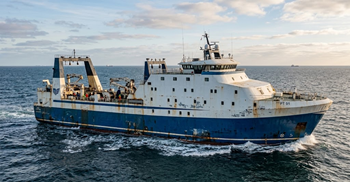
The M/V Excelsior is a heavily modified ocean-going vessel operating as the primary mobile operational node for Project eXcelsior. Externally registered as an industrial factory trawler navigating international waters, the vessel serves as a covert sanctuary, rapid-extraction base, and command center designed to operate beyond sovereign jurisdiction and government satellite surveillance.
Acquired through X-Corporation shell entities, the vessel’s interior was retrofitted by Forge with defense systems, bio-medical infrastructure, and advanced technological bays. Following the disappearance of the X-Men and key leadership after the July 15, 2026 crisis in San Francisco, the Excelsior was deployed to receive displaced mutant refugees and support covert field operations worldwide.
Vessel Origin & Maritime Service History
The vessel was originally commissioned in 2008 by Vard AS in Ålesund, Norway, launching under the name F/V Stjernen (Star). Designed as an ice-strengthened, heavy-weather stern factory trawler, the ship spent over a decade operating in the unforgiving waters of the North Atlantic and the Barents Sea. Throughout its thirteen years of commercial fishing service, the vessel built a reputation for exceptional structural resilience, maintaining stability and operational integrity even when navigating Sea State 6+ conditions.
In late 2021, following the financial liquidation of its parent fleet operator, the Stjernen was decommissioned and docked at a dry-storage quay in Rotterdam. The vessel remained listed on the open maritime asset market until mid-2023, when it was quietly purchased by Aegis Maritime Holdings—a Panamanian logistical shell corporation established by X-Corporation. Public maritime filings cited the acquisition as a commercial refit for deep-sea environmental survey work under the name M/V Northern Crest, masking its true destination.
Between late 2023 and early 2025, the vessel was stationed at a private, high-security dockyard in Bremerhaven, where it underwent a fourteen-month structural retrofit engineered by Forge. While the external hull was intentionally left unpolished and weathered to preserve its civilian appearance, the interior bulkheads were re-cored with vibration-dampening composite alloys, reinforced structural framing, and specialized electrical pathways. The vessel was formally commissioned into service for Project eXcelsior in early 2026, ensuring it was fully crewed, equipped, and quietly patrolling international waters months before the July 15 crisis in San Francisco.
Vessel Overview
Exterior & Hull Characteristics
The vessel’s exterior features an elevated, forward-positioned bridge and a multi-tiered superstructure finished in a standard commercial white-and-blue hull livery. To ensure maximum operational security and avoid drawing scrutiny from naval authorities or private maritime security, the hull maintains a cosmetics-grade weathered appearance. Stress marks, saltwater staining, and simulated hull rust are intentionally preserved across the exterior, masking the high-tech infrastructure beneath the facade of a well-worn, working commercial ship.
Aft of the main superstructure, the vessel is equipped with heavy-duty gantry arches, industrial winches, and mid-deck cranes. While these features maintain the outward profile of a standard deep-sea fishing or cargo operation, they are internally re-engineered to conceal launch mechanisms, radar-deflecting shrouds, concealed defensive emplacements, and retrieval systems for stealth watercraft and aerial vehicles.
Below the waterline, the vessel is driven by a heavy-duty industrial diesel main propulsion engine coupled with suppressed magnetohydrodynamic (MHD) drive arrays. This hybrid propulsion setup allows the Excelsior to cruise silently in international shipping lanes without generating the high thermal signatures or acoustic profiles detectable by modern military satellites and submarine tracking networks.
Deck Layout & Compartment Breakdown
The Excelsior is structured across five primary levels, ordered from the top of the vessel down to the lowest sub-deck, retrofitted from its original industrial blueprint to fulfill Project eXcelsior's multi-role mission parameters:
A-Deck: Navigation & Command (Bridge Deck)
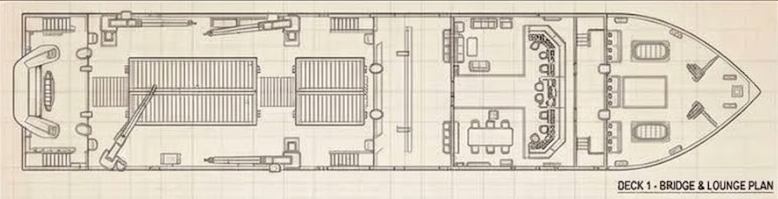
The highest level of the superstructure, providing primary command and oversight:
- Bridge: The central control room overlooking the forward bow. Features advanced radar arrays, electronic warfare suites, stealth telemetry controls, point-defense fire control, and helm navigation.
B-Deck: Operations & Officer Accommodations
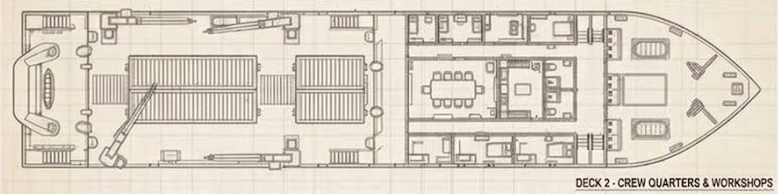
The secondary superstructure level managing vessel administration and mission planning:
- Captain's Quarters & Office: Living space and administrative suite for vessel logs, clearance keys, and command operations.
- Officer's Quarters: Dedicated accommodations for senior ship engineers, tactical leads, and navigation officers.
- Guest & Specialist Staterooms: Private quarters for visiting field operatives, high-value extraction targets, or diplomatic liaison staff.
- Meeting Room / War Room: Tactical planning suite equipped with holographic displays and secure satellite links to global X-Corporation branches.
- Triage Medical Bay & Bio-Decontamination: Secondary clinic and immediate intake station for emergency field care during extraction operations. Features an automated bio-decontamination lock to screen new arrivals for biological agents, tracking transponders, or sub-dermal surveillance tags before granting access to lower decks.
C-Deck: Main Operations & Refugee Sanctuary (Loading Deck)
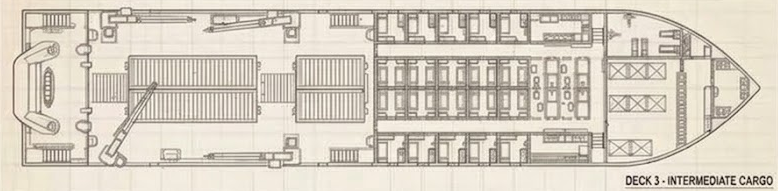
The primary deck spanning the main hull level, housing personnel, supplies, and deck access:
- Crew & Refugee Quarters: High-density modular living blocks fitted with bunking for up to hundreds of rescued mutant refugees and field operatives.
- Communal Mess & Galley: Main dining room, commercial preparation kitchen, and cold-storage pantries for extended ocean deployments.
- Sanitation & Facilities: High-capacity hygiene blocks and athletic gym for permanent crew and displaced civilians.
- Storage & Armory: Secure tactical lockers, small-arms armory, field gear storage, and emergency supply bays.
- Hold Access & Stern Slipway: Reinforced upper hatches over the lower cargo holds. The aft slipway houses two muffled, radar-absorbent Rigid-Hull Inflatable Boats (RHIBs) and a compact, remote-controlled autonomous sea drone used for low-profile coastal extractions in shallow waters.
D-Deck: Converted Hold Modules (Project eXcelsior Core)
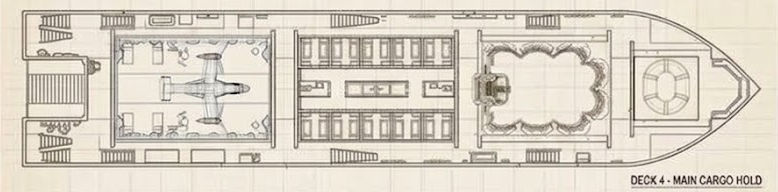
The primary cargo level running the length of the lower hull, completely re-engineered into four isolated operational modules:
- Forward Hold (Cerebro Chamber): Encased in electromagnetic shielding, this hold houses a portable Cerebro unit connected to the ship's encrypted sub-orbital communication array, enabling telepathic tracking and secure network pings.
- Mid-Forward Hold (Modified Danger Room): A compact, subterranean-spec Danger Room training chamber utilized for combat simulation, tactical readiness drills, and power-control training.
- Mid-Aft Hold (Medical & Technical Workshop Module): Houses a fully equipped surgical laboratory, intensive-care hospital unit, bio-containment suite, and machine shop for equipment fabrication and field repairs.
- Aft-Most Hold (Osprey Launch & Hangar Bay): Modified with a heavy-duty hydraulic elevator platform replacing the upper deck hatch. It houses a customized Bell Boeing V-22 Osprey retrofitted with radar-absorbent composite skin, active optical camouflage panels, suppressed engine shrouds, and extended-range auxiliary fuel bladders for transoceanic insertion missions.
E-Deck: Engine Room (Lowest Sub-Deck)
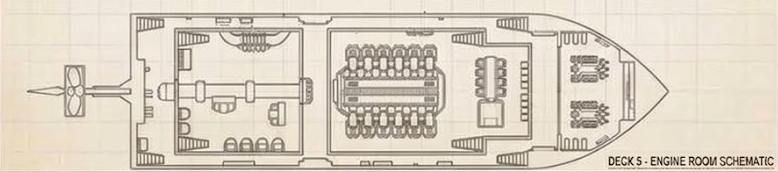
The lowest level of the ship, housing mechanical drives and energy generation:
- Main Engine Bay: Heavy industrial engine bay and primary drive units, retrofitted with suppressed plasma-assisted auxiliary cells for extended off-grid endurance.
- Engineering Workshops: Auxiliary power distribution, water filtration systems, and environmental scrubbers.
- Propeller & Rudder Assembly: Drive shaft housing, steering gear, and silent-running propulsion controls.
Countermeasures, Defense & Concealed Armaments
To safeguard refugees, high-value tech, and X-Corporation assets while maintaining its civilian cover, the Excelsior employs a multi-tiered defense architecture combining passive counter-surveillance, non-lethal deterrents, and hidden heavy armaments:
- Electronic Counter-Surveillance: High-powered radar spoofers and GPS signal distortion suites project false maritime AIS signatures (broadcasting as M/V Northern Crest), allowing the vessel to blend into standard commercial traffic or visually vanish from civilian tracking networks.
- Acoustic & Thermal Dampening: Integrated hull acoustic baffles and underwater exhaust scrubbers mask engine noise and heat output, rendering the ship practically invisible to standard military sonar and satellite thermal imaging while operating in hybrid MHD mode.
- Non-Lethal Boarding Defense: To deter pirate boarding parties or unauthorized coast guard inspections without resorting to lethal force, the superstructure is outfitted with high-intensity acoustic emitters (LRAD), variable-frequency strobe blinding arrays, and high-pressure hull-mounted water cannons.
- Concealed Kinetic & Missile Platforms: Hidden beneath pneumatically actuated deck plates and disguised as standard vent cowlings, winch houses, and life-raft canisters are pop-up Remote Weapon Stations (RWS) housing 30mm autocannons and heavy machine gun turrets. Additionally, containerized vertical launch system (VLS) cells are recessed into C-Deck, capable of deploying short-range interceptor missiles against anti-ship munitions or hostile aircraft.
- Directed-Energy Point Defense: Engineered by Forge, a solid-state high-energy laser turret is concealed within a modified radar dome atop A-Deck, capable of silently neutralizing incoming drones, light aircraft, or speedboat engines without producing gunpowder signatures or smoke.
- Waterline Torpedo & Decoy Arrays: Flush-mounted tubes near the stern slipway allow for the launch of anti-torpedo acoustic decoys, sonar jammers, or lightweight defensive torpedoes against sub-surface threats.
- Engagement Rules of Operation: Unmasking and firing kinetic or missile armaments is strictly governed by Level-4 Extreme Emergency Protocol. Because deploying heavy weaponry instantly exposes the vessel's cover to global intelligence networks, lethal armaments are authorized only when electronic warfare fails, non-lethal deterrents are breached, or destruction of the ship is imminent.
- Emergency EMP & Data Purge: In the event of an unavoidable breach or capture, the Cerebro chamber on D-Deck and the War Room on B-Deck are equipped with localized electromagnetic pulse emitters and thermite auto-destruct charges to instantly wipe sensitive mutant registries, operational logs, and telepathic network data.
Logistics & Resupply Pipeline
Maintaining months-long continuous deployments in international waters without pulling into public ports requires a highly specialized logistical strategy:
- Underway Replenishment (UNREP): The Excelsior relies on mid-ocean rendezvous with contracted X-Corporation commercial tenders and chartered supply vessels. Fresh rations, aviation fuel, specialized medical supplies, and spare parts are transferred via crane and cable transfers while adrift in international sea lanes.
- Bunker Fuel & Power Autonomy: While primary marine diesel fuel is acquired through automated transactions via maritime fuel barges in loose international jurisdictions, the ship's onboard plasma auxiliary cells dramatically reduce overall fuel consumption, extending operational range by up to three hundred percent compared to standard trawlers.
- Water & Waste Management: High-capacity desalinization plants and bio-digesting environmental scrubbers on E-Deck allow the ship to generate thousands of gallons of fresh potable water daily and manage waste internally, eliminating the need for shore-side disposal services.
- Shell Company Infrastructure: Supply purchases, maritime registry fees, and satellite bandwidth contracts are processed through a rotating web of international X-Corp subsidiary shell corporations, preventing intelligence agencies and anti-mutant groups from tracing the vessel's financial trail back to Project eXcelsior.
Operational Role & Mission
- Maritime Safe Passage Pipeline: Operating off coastal zones worldwide, the Excelsior serves as an offshore safehouse for refugees escaping anti-mutant violence, Purifier attacks, or Sentinel Services raids.
- Mobile Tactical Base: Using its hidden V-22 Osprey launch bay on D-Deck, the ship can insert and extract Contingency Response Teams into contested airspaces without alerting military tracking networks.
- Continuity Hub: Integrated into the X-Corporation network via its forward Cerebro unit, the vessel ensures mutant tracking, telepathic communication, and command infrastructure remain fully operational while land-based facilities like the X-Mansion remain compromised or destroyed.
Categories: No categories found