

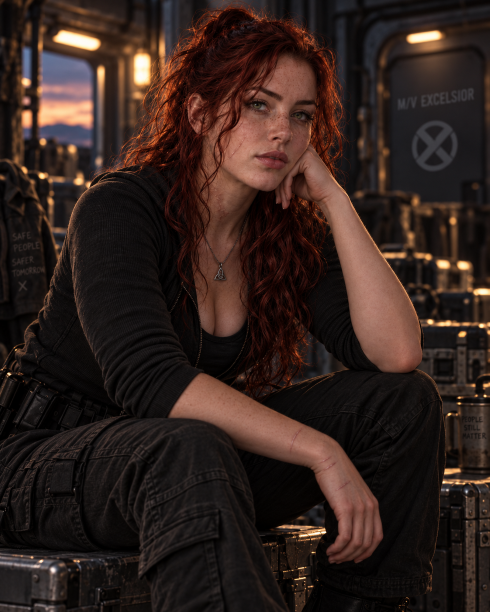
Niamh (Neeve) Keane
Name Niamh (Neeve) Keane
Position Executive Officer
Second Position Squad Leader
Character Information
| Gender | Female | |
| Orientation | Bisexual | |
| Age | 22 |
Family
| Father | Ciarán Keane (49) | |
| Mother | Siobhán Keane (47) | |
| Sibling(s) | Aoife Keane (25) – Older sister Oisín Keane (18) – Younger brother Clodagh Keane (15) – Younger sister |
Health
| Personality | Niamh is sharp-minded, strong-willed and far more difficult to intimidate than her age might suggest. Years of being controlled have left her instinctively suspicious of authority, confinement and anyone who assumes they know what is best for her, and she has a stubborn habit of pushing back simply because somebody expects obedience. She can be funny, dry and unexpectedly playful when she feels safe, with flashes of the spirited Galway girl she might have grown into under different circumstances. That warmth is genuine, as is her capacity for loyalty, but neither comes easily. Niamh feels everything intensely and does not always regulate those emotions well; anger can become recklessness, fear can become control, and hurt often arrives disguised as sarcasm, defiance or withdrawal. Under severe stress, traces of her original Irish cadence tend to return along with considerably less restraint in what she says. For all the damage done to her, Niamh has retained a fundamentally decent heart. She cares deeply about people in danger and has an especially strong reaction to coercion, captivity and the abuse of those unable to defend themselves, even while recognising the uncomfortable hypocrisy in her own history of manipulating minds. She is a capable field leader because she pays attention to the people around her and reacts quickly when they are threatened, not because she is naturally calm or infallible. She can become overprotective, take failure personally and struggle to distinguish helping someone from deciding for them. Niamh is still young enough to make bad calls, hold grudges, argue past the point of usefulness and occasionally make a complete arse of herself. What matters is that she keeps trying to become someone whose choices are genuinely her own, rather than the person SAAG trained Whisper to be. |
|
| Physical Description | Niamh Keane is a strikingly attractive young woman, standing around 5'7" with a fit, naturally curvaceous build shaped by years of physical conditioning rather than conspicuous muscle. Strong through the legs, shoulders and core, she carries herself with the unconscious balance of someone taught to remain ready without looking threatening. Her figure remains distinctly feminine, with a narrow, toned waist. Deep copper-red hair, thick and usually kept tied back or braided when working, frames a fair complexion dusted with light freckles across the bridge of her nose and upper cheeks. Her eyes are a clear, vivid green, darker around the outer iris, set beneath expressive brows and complemented by defined cheekbones, a softly tapered jaw, straight nose and full lips. There is an almost disarming perfection to Niamh's appearance, something SAAG quickly recognised as useful and taught her to exploit through posture, eye contact, clothing and carefully controlled body language. When relaxed she can look noticeably younger than twenty-two, warm and approachable in a way that makes the intensity she carries easy to miss. When that social softness falls away, however, her gaze becomes much harder to ignore, particularly given the uncomfortable knowledge of what she may be sensing behind someone else's eyes. The years in SAAG have left surprisingly little obvious evidence on her body, largely because she was considered too valuable to damage unnecessarily, though faint irregular scar tissue around parts of her neck remains from repeated collar use, accompanied by a handful of smaller restraint and training scars. |
Mutation
| Code Name | Whisper (SAAG callsign) | |
| Mutation (Primary) | Telepathy/Mind Control | |
| Mutation (Secondary) | Telekinesis (Emerging) | |
| Power Level | Level 4 |
| Biography | Galway Niamh (Neve) Keane was born in Galway, Ireland, in 2004, the second child of Ciarán and Siobhán Keane. She grew up with her older sister, Aoife, and later became an older sister herself to Oisín and Clodagh. There was nothing extraordinary about the Keane family in those early years. They were neither wealthy nor politically connected, and mutant affairs were something discussed through television reports and newspaper headlines rather than around their own kitchen table. Niamh's childhood was busy, affectionate and sometimes chaotic in the ordinary way of a household with several children competing for space and attention. Even before her mutation emerged, Niamh had a stubborn streak that could exhaust the adults around her. She was bright, curious and prone to challenging anything she considered unfair, particularly when someone expected obedience without giving her a reason for it. She could be warm and sociable when comfortable, fiercely protective of her younger siblings and infuriatingly persistent once she had decided that she was right. Those traits were not created by what came later. If anything, they became some of the few parts of her childhood that survived it intact. Her X-Gene began expressing when she was around ten years old, although there was no single dramatic manifestation that immediately revealed what she was. At first, her parents noticed small things that could be dismissed individually. Niamh answered questions before they were asked, became upset by arguments that had not yet started and occasionally accused somebody of saying something they insisted had never left their mouth. She complained that rooms were too loud even when nobody was speaking, struggled increasingly with crowds and began sleeping badly, sometimes waking from dreams that did not appear to belong to her. The explanations gradually became harder to sustain. Niamh repeated private thoughts she could not possibly have overheard and knew things about family members that nobody had told her. What frightened her most was not simply that she could hear people, but that she had no understanding of what she was hearing. A passing flash of resentment felt as genuine as hatred. An intrusive thought could seem indistinguishable from intent. Adults said one thing while thinking another, and at ten years old Niamh did not possess the experience to understand that contradiction as an ordinary part of being human. It became worse when the flow stopped being one-way. Niamh discovered that she could push her own thoughts into another person's mind, initially without meaning to. When one of her younger siblings became frightened during an argument, Niamh desperately wanted them to calm down. They did, with a suddenness that felt wrong even before anyone understood why. On another occasion, one of her parents tried to leave while Niamh was distressed, and the panicked thought that they should stay became more than a wish. For several seconds they simply could not make themselves move. Niamh released them almost immediately and was horrified by what she had done. Her parents were frightened too. The People Who Came to Help Ciarán and Siobhán sought assistance because they no longer believed they could safely manage what was happening at home. Their fear was not entirely for themselves. There were other children in the house, and Niamh's abilities were becoming stronger while her control remained unreliable. They wanted to protect their family and, whatever Niamh would later believe about their decision, they also wanted to help their daughter. The organisation that eventually reached them did not present itself as an intelligence programme. Its representatives spoke instead about specialist treatment, enhanced-genetic counselling, behavioural support and access to experts familiar with unusual manifestations. Niamh would receive medical care and training designed to help her control the thoughts overwhelming her. The placement was described as temporary, something that could be reviewed once she was stable enough to return home without posing a danger to herself or anyone else. By then, unfortunately, Niamh's telepathy had developed enough that reassuring words could not conceal what sat behind them. Her mother loved her and was frightened of her. Her father promised she would come home while feeling a guilty relief that the other children might finally be safe. Neither emotion meant what Niamh believed it meant, but she was ten years old and already drowning in information she did not know how to interpret. When her parents signed the papers allowing strangers to take her away, she did not understand frightened parents making an impossible decision. She understood that the people who were supposed to want her had decided the family was safer without her. That interpretation would prove extremely useful to the people who took custody of her. PSI-12 The organisation behind Niamh's placement was a deeply compartmentalised intelligence programme known internally as the Special Activities Assessment Group. SAAG existed behind enough layers of government offices, defence arrangements and private contractors that responsibility could be shifted whenever necessary. To most of the outside world, and to many people working in adjacent programmes, it effectively did not exist. Within SAAG, Niamh gradually stopped being treated as a frightened Irish child with an uncontrolled mutation and became PSI-12. Testing quickly demonstrated that her abilities extended well beyond passive telepathy. Niamh could perceive surface thoughts, deliberately push deeper into memory and intention, project words and impressions directly into another mind and influence a person's immediate behaviour. With practice, influence developed into something considerably more dangerous. She could impose commands strongly enough that another person experienced them as an irresistible need to comply. SAAG recognised the implications long before Niamh did. Her earliest years inside the programme combined ordinary education with psychological assessment, medical experimentation and structured power training. The medication began as something close to genuine treatment. Suppressants softened the constant mental noise and gave Niamh periods in which the people around her no longer seemed to be shouting silently into her head. After months of exhaustion and frightened sleeplessness, the sudden quiet felt miraculous. That dependence gave SAAG leverage almost immediately. Dosage could be adjusted according to behaviour, cooperation rewarded with enough suppressant to sleep comfortably while resistance meant longer periods exposed to the full pressure of surrounding minds. When chemical management was insufficient, physical restraint and an inhibitor collar provided more direct control. The collar suppressed her mutation almost completely and became associated with punishment, transport and moments when the people responsible for her decided she had become too dangerous to manage by less invasive means. Niamh resisted often enough that everyone involved became familiar with the procedure. She was never docile by nature. Fear could make her obedient for a time, medication could slow her down and punishment taught her when open resistance would accomplish nothing, but none of it produced the unquestioning compliance SAAG would have preferred. Niamh argued, tested boundaries and occasionally lashed out with her powers when frightened or angry. As she grew older, those incidents became more dangerous, which only strengthened the programme's conviction that its methods were necessary. Whisper As Niamh entered adolescence, SAAG's priorities shifted from understanding her abilities to finding practical uses for them. Once she began accompanying operational personnel, she was assigned the field callsign Whisper, a name that gradually became more familiar to many of the adults around her than Niamh itself. Her training was specialised rather than comprehensive. SAAG had no reason to manufacture an all-purpose intelligence officer when her mutation already allowed her to accomplish things conventional operatives could not. She was taught enough close-quarters combat to protect herself and create space to escape, along with competent firearms handling, tactical movement, extraction procedures and basic field medicine. Intelligence training concentrated on recognising useful information, understanding operational priorities and reporting what she learned without losing herself inside the enormous amount of irrelevant material that every human mind produced. Language training followed operational need. English and Irish belonged to her childhood, while additional languages were introduced according to where SAAG expected to deploy her and which foreign intelligence targets were considered strategically useful. She became capable in some areas and merely serviceable in others. Niamh was never the polished master of every discipline that later rumours occasionally made her out to be. She did not need to be. When conventional tradecraft failed, somebody usually expected her telepathy to bridge the gap. That was where the real training concentrated. SAAG taught her to distinguish memory from imagination, fleeting emotion from committed intention, deliberate lies from things a subject genuinely believed and surface thoughts from information buried beneath conscious attention. She learned to push through resistance and maintain contact while under stress. Just as importantly, she was taught to use psychic influence deliberately rather than waiting for instinct or emotion to trigger it. The early exercises were innocuous enough. Ask somebody to put down an object. Make them turn their head. Convince them they had forgotten why they entered a room. Over time, the commands became less harmless. Guards were persuaded to ignore people who should not have been there. Subjects disclosed information they had resisted giving. Targets walked willingly towards waiting operatives because Niamh had convinced their nervous systems that compliance was the safest choice. Eventually, SAAG used her abilities in operations where people died. Sometimes Niamh was directly compelled to cooperate. Sometimes she was medicated heavily enough that memory of an operation remained fragmented afterwards. Other occasions are more difficult for her to excuse, particularly as she grew older and understood more clearly what she was doing. She invaded minds because she had been told there was intelligence inside them that mattered. She forced people to act against their own interests because everyone around her treated psychic coercion as a legitimate operational tool. At least some of those actions contributed directly to deaths, whether or not Niamh herself held the weapon that caused them. Most of the details remain things she refuses to discuss. A Dangerous Asset For all the value SAAG placed upon Niamh, genuine trust never followed. She was a mutant during a period in which political and public attitudes towards mutantkind were worsening, and her particular mutation touched upon one of the most instinctive fears surrounding powerful psionics. Niamh did not merely possess information people wanted kept secret. She could potentially take it from them. Worse, she could make them act in ways they had never chosen. As a result, the people around her lived with a persistent contradiction. They trained her extensively, depended upon her in the field and described her abilities as strategically invaluable while simultaneously behaving as though she might become catastrophic if allowed too much freedom. Niamh was seldom left unsupervised within secure facilities. Certain briefings were deliberately sanitised before she entered, while personnel involved with her programme practised mental exercises and experimented with technologies intended to complicate unwanted psychic access. Weapons were carefully controlled around her, medication records maintained with obsessive precision and the inhibitor collar remained available whenever those responsible for her decided the risk had become unacceptable. Growing up surrounded by that atmosphere changed the way Niamh understood people. She heard hatred that was never spoken aloud and fear concealed behind professional courtesy. Some personnel thought of her as a freak, a weapon or something less than human even while smiling at her across a table. Others were genuinely kind. Those people left a more complicated mark. There were nurses who worried about her appetite after difficult sessions, instructors who brought books she had asked for and security personnel who made a point of using her name rather than her designation. Some of them privately hated what was being done to her, feelings Niamh could perceive clearly enough to know they were sincere. Yet most still performed their assigned roles. A person could think that she was only a child while fastening the restraints around her wrists because procedure required it. One of the hardest lessons Niamh learned inside SAAG was that kindness and courage were not the same thing. Another was that thoughts themselves could lie in ways words did not. People imagined cruel things they would never do, felt anger they did not truly believe and experienced flashes of fear they were ashamed of moments later. SAAG taught her to separate that mental noise because reliable intelligence depended upon it. Inadvertently, they also gave her the tools she needed to avoid growing into somebody who hated everyone around her for every ugly thought she overheard. Learning to Lead SAAG did not deliberately prepare Niamh for command. Too much independence would have undermined the control the programme worked so hard to maintain. Her ability to lead others emerged instead through field experience and the practical consequences of her mutation. Niamh discovered that she could maintain low-level psychic communication between several people at once, passing warnings and immediate information through a team without relying entirely upon radios or shouted instructions. She could notice that someone had seen movement at the opposite end of a building and relay the danger before they finished reaching for the transmit button. She could sense panic building in an operative before it became visible and identify hostile intent before a weapon was fully drawn. Experienced personnel learned to pay attention when Whisper warned them. Eventually they started asking her judgement rather than waiting for her to volunteer it. That did not transform Niamh into some flawless young commander. She was good at maintaining awareness of the people around her and instinctively protective of those operating alongside her, but those same qualities could become weaknesses. She had difficulty stepping back when somebody she considered her responsibility was endangered and could become controlling when frightened, particularly when she believed she possessed information other people did not. Disagreement sometimes felt more personal than it should, while mistakes could provoke a disproportionate sense that she ought to have prevented them. She was also still young. Niamh could sulk, lose her temper, make reckless decisions and dig herself into arguments long after she realised she was wrong. The discipline drilled into Whisper did not erase the young woman underneath it. If anything, the stubborn refusal to let SAAG completely define her probably preserved more of Niamh Keane than the programme ever understood. Escape By 2024, Niamh was twenty years old and increasingly difficult to manage. Her telepathy had continued maturing, while years of field operations had taught her far more about the systems surrounding her than SAAG intended. She understood how personnel rotated, how procedures overlapped and which individuals feared her enough to advocate increasingly restrictive measures. More dangerously for the programme, she could hear what people thought when they believed she was sufficiently medicated not to notice. Niamh gradually learned that some senior personnel no longer believed ordinary conditioning would remain effective indefinitely. Her emotional resistance was becoming a problem, particularly when operations crossed lines she was increasingly unwilling to ignore, and proposals were being discussed for a more invasive neurological control protocol designed to reduce those difficulties. She did not wait to discover exactly what that meant. Someone inside SAAG helped her, although the assistance fell well short of a heroic rescue. One person made one decision at the correct moment, compromising a security measure that should have remained intact and giving Niamh an opportunity she might never receive again. She took it. The escape was violent because nothing about the life SAAG had built for her made a peaceful departure realistic. Niamh used mental control against the people trying to stop her and injured others while forcing her way out. At least one death may ultimately have resulted from decisions she made during those hours, something she has never been able to reduce comfortably to either self-defence or guilt. She gained her freedom using the very abilities the programme had spent ten years weaponising. There was no clean line between captivity and everything that came afterwards. Two Years Outside The skills SAAG had given Niamh proved considerably better at helping her disappear than helping her live. Between 2024 and 2026 she moved frequently, relying on false identities, temporary accommodation and whatever work or money she could obtain without drawing attention. She avoided government systems whenever possible and rarely remained anywhere long enough to develop relationships she could not abandon quickly. Her powers made survival easier, and she used them with considerably less restraint than she would later prefer to admit. Hotel staff remembered payments she had not made. Officials decided questionable paperwork was perfectly adequate. Drivers became unusually willing to help. People threatening her sometimes found themselves suddenly convinced that leaving was the most sensible thing they could possibly do. When she needed money badly enough, individuals she considered wealthy or unpleasant occasionally became temporarily generous. At first, Niamh saw little wrong with it. Psychic manipulation had been normalised throughout her adolescence, and she no longer had handlers around to draw even SAAG's heavily self-serving boundaries. It was only through living amongst ordinary people that she began recognising how thoroughly the programme had distorted her understanding of consent. The lesson did not arrive as a single revelation. She saw fear in somebody's face after releasing them from a command. She realised that a person who had been genuinely trying to help her had been manipulated simply because doing so was easier than trusting them. Small moments accumulated until Niamh began constructing rules for herself, imperfect and occasionally broken, but chosen rather than imposed. Living without the suppressants created another struggle. By the time the physical effects of withdrawal had passed, it was clear that Niamh had spent much of her neurological development learning psychic control with chemical assistance. Her adult telepathy was louder and less forgiving without it. Crowded spaces could become exhausting, strong emotions sometimes pushed unexpectedly across her barriers and sleep remained difficult because deliberate shields weakened as concentration faded. She adapted because she had little alternative. The result was not perfect control so much as a hard-earned working arrangement with her own mind. During those years, another ability began appearing at the edges of her awareness. Objects shifted during moments of intense emotion. Something dropped might hesitate before striking the floor. A door once moved violently without Niamh touching it when somebody startled her awake. She resisted thinking about those incidents for as long as possible. Telepathy was dangerous, but familiar. Whatever was beginning to emerge alongside it had no rules she understood. July 15 By July 2026, Niamh had become very good at recognising when circumstances were becoming dangerous and leaving before anyone realised she had been there. San Francisco gave her every reason to follow that instinct. She was in the city under another identity when the peace rally descended into violence. Purifiers opened fire on the gathering, uncontrolled mutant manifestations erupted amid the panic and the conflict rapidly expanded into a wider urban battle involving Sentinels and a conspiracy intended to seize control of mutant minds. Niamh could have left. For a short time, she tried. The problem was that escaping a crowd physically did nothing to silence it. Fear struck her from every direction. She could feel people searching desperately for children, relatives and exits that no longer existed. Human and mutant minds were indistinguishable in their panic, and somewhere amidst it all Niamh realised that she was doing exactly what she had spent the previous two years doing whenever the world became dangerous. She was leaving. This time she turned back. Nobody announced Whisper's arrival and Niamh had no interest in changing that. She worked through the edges of the fighting rather than joining the famous mutants at its centre, directing civilians towards routes she could determine were still open and reaching frightened mutants who could no longer hear conventional instructions over the violence around them. Armed attackers were compelled to lower weapons or look elsewhere long enough for people to escape, while others found their bodies refusing to cooperate when they tried to fire. Some of those methods felt disturbingly familiar. Under pressure, years of SAAG conditioning returned easily because the techniques had never stopped working merely because Niamh had begun questioning whether she should use them. The attempt to broadcast a control signal across mutant minds affected her particularly badly. Niamh had spent most of her childhood being medicated, collared and conditioned by people determined to control what happened inside her head. When another force tried to impose itself there, resistance came with years of accumulated anger behind it. She fought the intrusion while instinctively extending whatever protection she could towards nearby mutants, pushing her telepathy harder than she had since leaving SAAG. She survived. Something about her psychic control did not emerge from San Francisco untouched. The barriers she had developed during two years of freedom became less predictable for a time, emotional bleed-through increased and the strange physical disturbances she had been refusing to acknowledge became more difficult to dismiss. Telekinesis, long suppressed or simply undeveloped beneath years of medication, was beginning to emerge alongside her telepathy. What mattered more to Niamh was the choice she had made before any of that happened. Nobody had ordered her back into those streets. There had been no handler waiting with medication, no collar around her throat and no threat hanging over the lives of other people if she refused. She had been free to leave and had chosen, entirely on her own, to help. For someone who had spent most of her life believing that every useful thing she did had ultimately belonged to somebody else, that distinction proved difficult to ignore. Project eXcelsior The aftermath of July 15 made the world Niamh had been navigating increasingly difficult to survive alone. With the X-Men and Brotherhood gone from public sight, grassroots sanctuary networks became the primary defence available to mutants facing expanding government containment and Sentinel operations. Project eXcelsior had been designed precisely for that collapse, maintaining safehouses, contingency infrastructure and mobile operational resources such as the M/V Excelsior for the protection and extraction of threatened mutants. Niamh did not seek it out because she suddenly wanted to become an X-Man or inherit somebody else's dream. Organisations still made her suspicious, particularly those with secure doors, medical facilities and people claiming to know what was best for her. Trust remained something she rationed carefully. What San Francisco had taken from her was the comfortable lie that she preferred being alone. She cared what happened to people. Worse, from Niamh's perspective, she had proved it to herself. The abilities SAAG had developed for exploitation now had obvious uses in keeping people alive. The instincts she had acquired while working alongside field teams could help bring frightened mutants home rather than deliver targets into custody. Her unusual ability to maintain awareness across a squad made her valuable in exactly the sort of dangerous extraction work Project eXcelsior increasingly needed. None of that makes Niamh an effortless leader. She remains young, occasionally volatile and still learning the difference between protecting somebody and deciding for them. She distrusts authority while sometimes slipping unconsciously into the same controlling habits she resents in others. Her first instinct is still often to solve a problem psychically because for most of her life that was exactly what everyone expected from her. She is trying to change those instincts without pretending they never existed. Her family remains in Ireland. Niamh has had enough freedom, training and ability to discover that much and could find them if she chose. She has not. Returning to Galway would mean facing parents who genuinely loved her and nevertheless signed the papers that allowed somebody else to take her away, as well as siblings who have spent twelve years growing up without her. SAAG exploited that wound for years, but they did not create it, and Niamh has never decided what forgiveness would even mean. For now, Project eXcelsior offers something she has never previously experienced for very long: a place where being useful does not automatically mean being owned. Whether she knows how to live with that remains another question. |